

Essential Substation Safety Signs for Safer Work

A substation fence, transformer enclosure, lineup, or control room can look routine to the people who work near it every day. That familiarity is precisely why essential substation safety signs matter. A clear warning at the point of exposure gives employees, contractors, and visitors the information they need before they cross a boundary, open a door, operate a disconnect, or begin work on equipment that may be energized.
Substation signage is not decoration and it is not a substitute for a qualified electrical worker program. It is a visible part of hazard communication that supports safe work practices, equipment identification, lockout/tagout, and controlled access. When signs are incomplete, illegible, generic, or placed where no one sees them, the facility loses a critical layer of protection.
What Essential Substation Safety Signs Must Communicate
The right sign depends on the equipment, voltage, available incident energy, access arrangement, and work performed at the site. A transmission substation, for example, may require extensive perimeter and restricted-access warnings, while an industrial facility substation may need more detailed labels on switchgear, transformers, secondary distribution, batteries, and control equipment.
At a minimum, the sign program should answer practical questions before a person is exposed to a hazard: Is this area restricted? Is the equipment energized? What voltage is present? Is there an arc flash or shock hazard? Who is authorized to enter or operate the equipment? What must be isolated before maintenance begins?
The following categories address the hazards most commonly overlooked in facility substation areas:
High-voltage and electrical hazard warnings identify equipment and enclosures that can expose personnel to dangerous voltage, shock, electrocution, or arc flash hazards.
Restricted-access and authorized-personnel signs establish the boundary between public or general employee areas and electrical spaces limited to qualified or specifically authorized workers.
Arc flash and shock hazard labels provide equipment-specific information developed through an arc flash risk assessment, including nominal voltage, incident energy or PPE category where applicable, arc flash boundary, and limited approach boundary.
Equipment identification labels identify switchgear sections, transformers, disconnects, feeders, breakers, and source equipment so workers can follow drawings, one-line diagrams, and lockout procedures accurately.
Lockout/tagout and operating instruction labels identify energy-isolating devices and reinforce the requirement to de-energize, lock, tag, and verify absence of voltage before work begins.
Battery, chemical, and fire hazard signs address stationary battery systems, electrolyte exposure, explosive gas potential, emergency eyewash requirements, and other hazards associated with stored-energy systems.
A site does not necessarily need every sign in every location. Applying generic warnings everywhere can reduce their value. The objective is specific, visible communication that reflects the real hazards and operating conditions of each asset.
Essential Substation Safety Signs at the Perimeter and Entry Point
The perimeter is the first decision point. Fences, gates, enclosure doors, and building entrances should make it clear that the area contains electrical equipment and that entry is limited. High-voltage danger signs should be placed where a person is likely to approach or attempt entry, not hidden behind a gate or mounted so high that they cannot be read.
For outdoor substations, signs must be visible from expected approach paths and durable enough to withstand ultraviolet exposure, moisture, temperature swings, cleaning, and abrasion. A paper-based sign that fades or detaches after a season does not provide reliable hazard communication.
Access signs should also align with the facility's actual policy. “Authorized Personnel Only” is useful when authorization is defined and enforced. If a site requires qualified electrical workers for entry or specific tasks, the wording and training program should support that requirement. A sign cannot make an unqualified worker qualified, but it can reinforce the access controls management has established.
Arc Flash Labels Need Current Engineering Data
Arc flash labels are among the most consequential signs on substation equipment because they inform work planning and PPE selection. NFPA 70E requires equipment likely to require examination, adjustment, servicing, or maintenance while energized to be field marked with an arc flash warning label. The label information must be based on a current arc flash risk assessment and appropriate for the equipment.
A generic “Arc Flash Hazard” decal is better than no warning, but it is not a replacement for an engineered label where NFPA 70E labeling applies. Workers need usable information at the equipment, including the nominal system voltage and the arc flash boundary. Depending on the labeling method, the label may also state available incident energy and working distance, a minimum arc rating for clothing, a PPE category, or other data necessary for the facility's electrical safety program.
Accuracy is the central issue. A label becomes questionable when protective device settings change, a transformer is replaced, available utility fault current changes, equipment is reconfigured, or the one-line diagram no longer reflects field conditions. Facilities should include label review in their management-of-change process rather than treating the arc flash study as a one-time project.
Equipment Identification Prevents Wrong-Equipment Work
Many electrical incidents begin with a simple but serious error: a worker opens, tests, operates, or locks out the wrong piece of equipment. Clear, consistent equipment identification reduces that risk by connecting field assets to operating procedures, maintenance records, panel schedules, and one-line drawings.
In a substation, identification may be needed on transformer primary and secondary disconnects, switchgear cubicles, main breakers, tie breakers, feeder breakers, control panels, relay cabinets, grounding switches, battery chargers, and emergency power sources. Labels should use the same naming convention used in facility documentation. If the one-line calls equipment “MS-1,” but the door is marked “Main Switchgear,” workers are left to interpret rather than verify.
Direction matters as well. Source labels and feeder destination labels help workers understand what equipment is supplied by a disconnect or breaker. This is especially valuable where equipment is fed from multiple sources, supplied by backfeed-capable generators, or connected to solar, battery, or other distributed energy systems.
Labeling Supports Lockout/Tagout, but Does Not Replace It
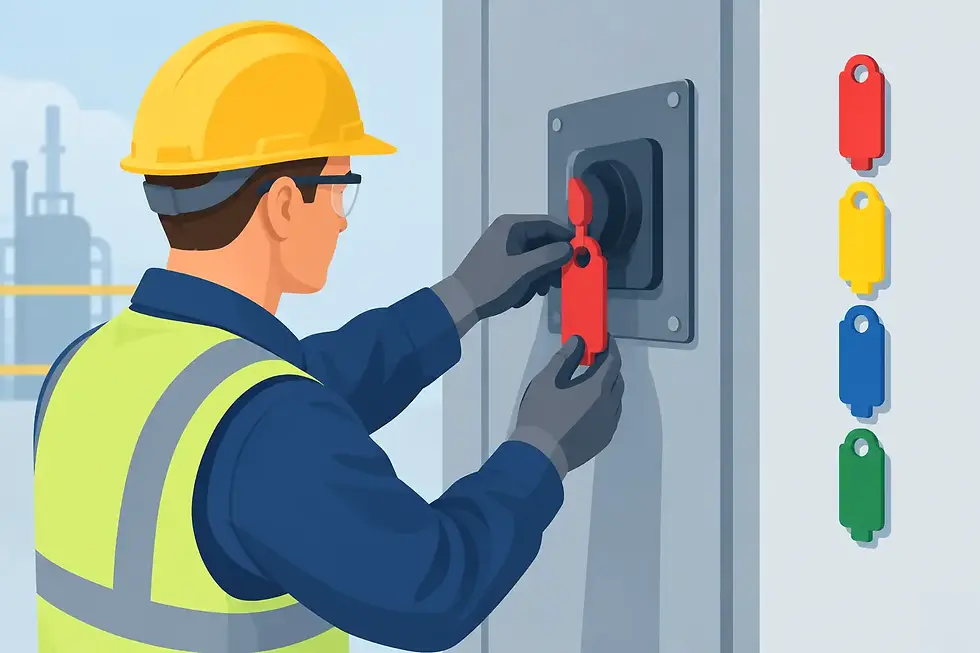
OSHA lockout/tagout requirements depend on a formal energy-control program, trained employees, written procedures, locks, tags, and verification. Labels support that system by making disconnecting means and energy sources identifiable in the field.
A disconnect label should be durable, unambiguous, and consistent with the equipment name in the written lockout procedure. It should help an authorized employee identify which device controls the intended energy source, but it should never imply that opening a handle alone makes the equipment safe. Electrical workers must follow the facility's established process for isolation, lockout, tagout, release of stored energy, and verification of absence of voltage using properly rated test instruments.
This distinction is particularly important in substations with capacitor banks, batteries, generators, UPS systems, or multiple transformer feeds. De-energizing one source may not eliminate all electrical or stored-energy hazards.
Standards Should Guide the Sign Program
A defensible substation labeling program should be informed by the standards and regulations that apply to the site. OSHA requirements address electrical safety and hazard communication in the workplace. NFPA 70E provides the framework for electrical safety-related work practices, including arc flash risk assessment and equipment labeling. The National Electrical Code includes field-marking requirements for specific equipment and installations. ANSI Z535 principles can help facilities use consistent safety colors, signal words, symbols, and message formats.
For Canadian facilities or equipment built for Canadian use, CSA Z462 and applicable provincial requirements may also affect the program. Local utility rules, owner specifications, insurer expectations, and customer requirements can add another layer. The practical answer is not to apply every possible label. It is to identify the requirements that govern the installation, then document a consistent approach that workers can understand and maintain.
Build Signs Into Inspection and Maintenance Work
The most effective sign programs are maintained like other safety-critical controls. During electrical preventive maintenance, inspect labels for fading, lifting edges, damaged print, paint overspray, corrosion, incorrect equipment names, and obstructed placement. Replace labels when equipment is modified, not months later after someone notices a discrepancy.
Material selection deserves the same attention. Substation environments can include heat, oil, dust, ultraviolet exposure, washdown, vibration, and chemical contact. Durable industrial labels with strong adhesive systems and legible print are better suited to these conditions than temporary paper notices. ZMAC Safety Labels supports this approach with industrial-grade electrical labels designed for field conditions and broader compliance needs.
Assign ownership for the program. Engineering may own the technical data, maintenance may install and inspect labels, and EHS may oversee training and audit performance. Without clear ownership, labels often become fragmented: a new panel gets marked, an old lineup keeps obsolete data, and no one is responsible for reconciling the difference.
A well-marked substation gives workers a reason to pause, confirm the hazard, and follow the right procedure before work begins. That moment of clarity at the equipment can prevent a wrong turn from becoming an electrical incident.


Comments