

OSHA Electrical Equipment Labeling Requirements

A faded panel label is not a small paperwork problem. When a qualified worker opens energized equipment, missing or unclear information can slow decision-making, increase exposure, and create preventable risk. That is why OSHA electrical equipment labeling requirements matter in real facilities - not just during an audit, but during troubleshooting, shutdowns, and emergency response.
For many employers, the challenge is not whether labels are necessary. It is understanding which labels OSHA clearly requires, where consensus standards like NFPA 70E shape best practice, and how to make sure labels stay legible in harsh industrial conditions. The answer is not one label for every asset. It depends on the equipment, the hazard, the task, and whether the label is communicating identification, shock risk, arc flash risk, disconnecting means, or lockout information.
What OSHA electrical equipment labeling requirements actually cover
OSHA does not regulate electrical labeling through one single, stand-alone rule that answers every field question. Instead, labeling obligations appear across several requirements tied to hazard communication, equipment identification, warning marking, and safe work practices. In practical terms, employers need to look at the equipment type and the employee exposure.
A common starting point is 29 CFR 1910 Subpart S for general industry electrical safety. OSHA requires certain equipment to be marked with the manufacturer’s name, trademark, or other descriptive marking and enough information such as voltage, current, wattage, or other ratings where needed. OSHA also requires warning signs where electrical hazards are likely to endanger employees. Those are not optional administrative details. They are part of providing a workplace where hazards are identifiable at the point of use.
OSHA also expects disconnecting means and circuits to be legibly marked to indicate their purpose, unless located and arranged so the purpose is evident. That matters in motor control centers, panelboards, switchboards, industrial control panels, and equipment served by multiple sources. If workers cannot quickly identify what a disconnect controls, isolation errors become more likely.
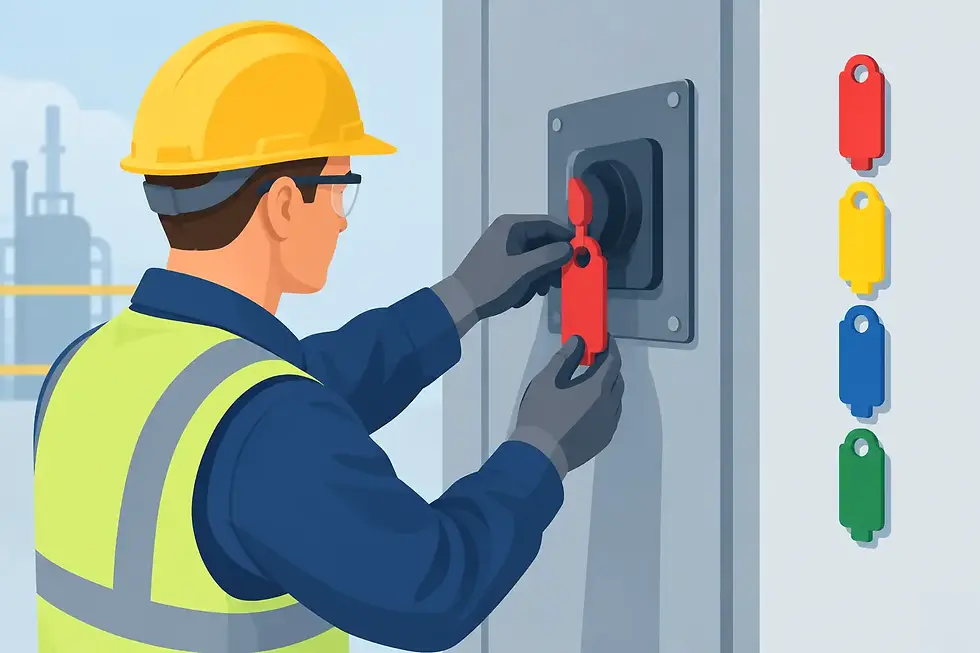
Then there is lockout/tagout under 29 CFR 1910.147. While OSHA’s lockout rule is not simply a labeling regulation, it directly affects how energy isolation points are identified and how tags are used in conjunction with lockout devices. Facilities that treat labeling, equipment identification, and lockout as separate programs often create gaps right where workers need clarity most.
Where OSHA ends and NFPA 70E becomes operationally important
One source of confusion is that OSHA does not spell out every detail employers ask for, especially around arc flash labeling. OSHA enforces safe workplace obligations, but it often relies on recognized industry practice and consensus standards to help establish what a compliant program looks like. That is where NFPA 70E becomes important.
NFPA 70E is not an OSHA regulation, but it is widely used as the operational framework for electrical safe work practices. For equipment likely to require examination, adjustment, servicing, or maintenance while energized, NFPA 70E calls for field marking with arc flash warning information. In most facilities, this becomes the practical basis for arc flash labels on switchboards, panelboards, industrial control panels, meter socket enclosures, motor control centers, and similar equipment.
That distinction matters. If you ask, “Does OSHA require arc flash labels in those exact words?” the answer is more nuanced than many expect. If you ask, “Can an employer reasonably manage energized work risk without hazard labeling aligned to accepted industry practice?” the answer is far less comfortable. For most industrial sites, arc flash labeling is part of a defensible electrical safety program, even when the regulatory path runs through both OSHA duties and NFPA 70E methods.
Equipment that typically needs clear labeling
The strongest labeling programs are built around exposure, not guesswork. Electrical panels and distribution equipment usually need identification that tells workers what the equipment is, what it serves, and what hazards are present. Disconnects should be marked clearly enough that their purpose is immediately understood. Equipment with multiple power sources needs source identification that prevents dangerous assumptions during servicing.
In many facilities, transformers need voltage and hazard identification. Battery systems may need shock, chemical, and explosion-related warnings depending on the installation. Solar equipment often requires highly specific markings due to multiple sources and backfeed concerns. Industrial control panels and machine disconnects need labels that support both normal operation and energy isolation.
Not every label is a danger label, and that is an important distinction. Some labels identify equipment. Some communicate ratings. Some warn of shock and arc flash hazards. Some support lockout/tagout execution. The most effective programs separate those functions clearly so workers are not sorting through clutter when time and attention are limited.
What an effective electrical hazard label should include
The content of a label depends on its purpose. A disconnect identification label should not be built the same way as an arc flash warning label. Still, a few principles hold across the board: the message must be accurate, legible, durable, and placed where the worker sees it before exposure.
For hazard warning labels, the core information usually includes the nature of the hazard, such as shock hazard or arc flash hazard, and the actions or restrictions needed to reduce risk. On arc flash labels developed under NFPA 70E methodology, facilities may include nominal system voltage, arc flash boundary, available incident energy and working distance, minimum arc rating of clothing, site-specific PPE category where applicable, or other required data depending on the calculation and labeling approach used.
This is where many facilities run into trouble. They use generic labels where calculated values are needed, or they apply calculation-based labels and never update them after system changes. A label is only as defensible as the engineering and field verification behind it. If protective device settings, transformer sizes, utility contributions, or equipment configurations change, the label may no longer reflect actual risk.
Durability is part of compliance, not a cosmetic issue
OSHA repeatedly uses the concept of legibility. In an electrical environment, legibility is not just about print size on the day of installation. It is about whether the marking survives heat, moisture, UV exposure, oil, abrasion, washdowns, and routine maintenance activity.
A paper label under a layer of tape may look acceptable at installation and fail months later. Engraved or industrial-grade printed labels built for the environment are often the better fit for switchgear rooms, process areas, rooftops, outdoor service equipment, and chemical environments. The right material depends on the substrate, temperature range, cleaning methods, and expected service life.
That is one reason many organizations work with providers that understand both labeling standards and industrial use conditions. ZMAC Safety Labels focuses on that intersection - labels that communicate the required message and remain readable in the environments where electrical work actually happens.
Common mistakes facilities make with OSHA electrical equipment labeling requirements
The first mistake is assuming a one-time labeling project closes the issue. Electrical systems change. Panels are modified, circuits are repurposed, and protective devices are adjusted. Labels have to be maintained as part of change management.
The second mistake is confusing NEC installation marking rules, OSHA workplace safety obligations, and NFPA 70E work practice guidance. All three can affect labeling, but they do not serve the same function. A code-compliant installation can still leave workers without sufficient field hazard information if the employer has not built a proper safety labeling program.
The third mistake is poor placement. A technically correct label that is hidden behind conduit, blocked by an open door position, or placed far from the access point will not help much at the moment of exposure.
The fourth is inconsistency. If one building uses equipment IDs, another uses room names, and a third uses outdated one-line references, workers and contractors lose confidence in the labels. Standardization improves both safety and speed.
Building a practical labeling program
The most reliable approach starts with an equipment inventory and a clear labeling philosophy. Decide which assets require identification labels, which require warning labels, which require arc flash labels, and how disconnects and energy isolation points will be marked. Align that approach with your single-line diagrams, lockout procedures, maintenance practices, and arc flash study data.
Then verify field conditions. This step matters more than many teams expect. Equipment names on drawings do not always match what is in the field, and legacy labels often remain long after modifications. Field validation prevents bad information from being permanently installed.
After that, focus on material selection and format. Labels should be readable from the expected approach distance and suitable for the environment. Wording should be direct. Signal words and formatting should be used consistently. If your site spans indoor electrical rooms, outdoor service gear, corrosive washdown areas, and high-heat process spaces, one label material may not fit every location.
Finally, assign ownership. Someone should be responsible for keeping labels current after engineering updates, shutdown projects, or equipment replacements. Without ownership, even a well-executed labeling rollout degrades into a mixed system of accurate, outdated, and missing markings.
Electrical labeling works best when it is treated as part of hazard control, not as an afterthought to satisfy an inspector. The right label, on the right equipment, with the right information, can remove uncertainty at the exact moment a worker needs clarity most.


Comments