
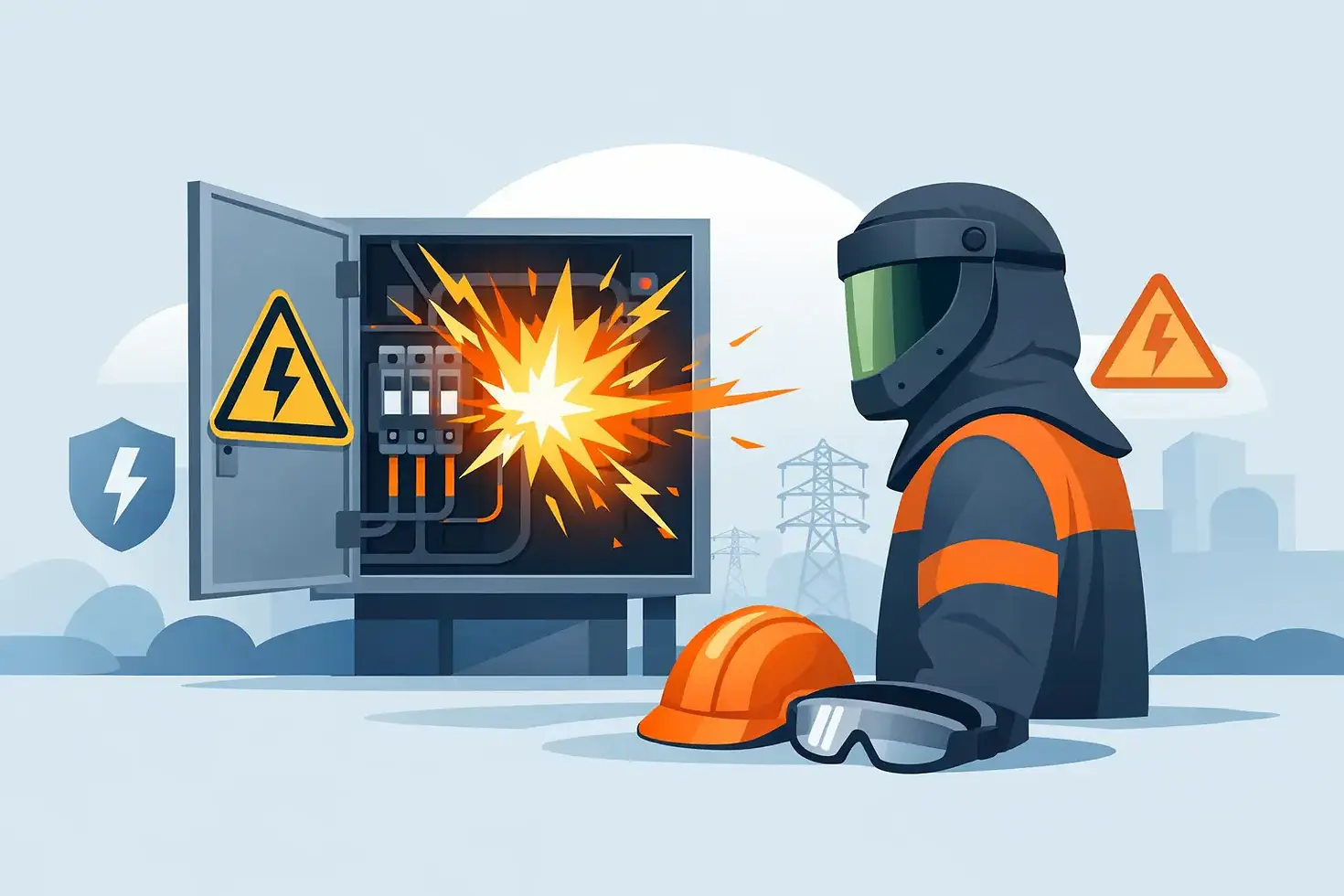
Arc Flash Warning Label Requirements

A missing or outdated label on energized equipment is not a paperwork problem. It is a worker-exposure problem. Arc flash warning label requirements exist so qualified people can see the hazard before they open a panel, rack out a breaker, or begin justified energized work.
For facilities that operate switchgear, panelboards, industrial control panels, MCCs, transformers, and similar equipment, labeling is one of the most visible parts of an electrical safety program. It also tends to be one of the most misunderstood. Teams often ask whether OSHA requires a specific label format, whether NEC and NFPA 70E say the same thing, and what information must actually appear on the label. The right answer depends on the equipment, the study method used, and how the site manages updates over time.
What standards drive arc flash warning label requirements?
In the US, arc flash labeling is shaped primarily by NEC and NFPA 70E, with OSHA serving as the enforcement backdrop for protecting workers from recognized electrical hazards. These documents are related, but they do not serve the same purpose.
The NEC addresses equipment field marking requirements. For certain equipment that is likely to require examination, adjustment, servicing, or maintenance while energized, the NEC requires a field-applied label that warns qualified persons of potential arc flash hazards. That requirement is centered on marking the equipment.
NFPA 70E goes further into workplace practice. It addresses electrical safety-related work practices, risk assessment, PPE selection, and the information needed to support safer decision-making at the point of use. In practical terms, many facilities rely on NFPA 70E to determine what hazard information should be shown on the label and how that information ties back to the arc flash risk assessment.
OSHA does not publish a single prescriptive arc flash label template. What OSHA does require is protection from electrical hazards, appropriate hazard communication, and a workplace where employees are not exposed to known risks without adequate safeguards. If a label is inaccurate, illegible, missing, or inconsistent with actual equipment conditions, that gap can become part of a broader compliance and liability problem.
Which equipment needs an arc flash label?
The NEC field-marking requirement generally applies to electrical equipment such as switchboards, switchgear, panelboards, industrial control panels, meter socket enclosures, and motor control centers that are in other than dwelling occupancies and are likely to require interaction while energized. The exact code language and scope can shift between code cycles, so facilities should confirm against the edition adopted in their jurisdiction.
That last point matters. Code adoption is not uniform across the country. A multi-site organization may have one facility operating under a different NEC edition than another. The safe approach is to align the labeling program with the most current applicable requirements and make sure engineering assumptions and field practices are documented.
There is also a practical issue beyond minimum code language. Some equipment may not be explicitly named in one requirement but still presents a meaningful arc flash or shock hazard during operation or maintenance. Many organizations choose to label additional equipment categories as part of a stronger site-wide electrical safety program rather than treating the bare minimum code list as the ceiling.
What information should an arc flash label include?
This is where many compliance efforts break down. A label should not be treated as a generic warning sticker. It should communicate equipment-specific hazard information that supports safe work planning.
Arc flash warning label requirements under NFPA 70E
NFPA 70E identifies several acceptable ways to present arc flash information on a label. Depending on the method used in the arc flash risk assessment, the label may include nominal system voltage, arc flash boundary, and at least one of the following: available incident energy and the corresponding working distance, the minimum arc rating of clothing, site-specific PPE level, or the highest hazard/risk category only where that method is still being applied under an older program framework.
Many facilities today use incident energy as the primary label output because it is specific to the equipment and task assumptions used in the study. That said, a label is only as good as the underlying engineering. If protective device settings have changed, equipment has been modified, or the utility contribution is different from the study assumptions, the printed incident energy may no longer be reliable.
Shock-related information is often included as well, even when the discussion focuses on arc flash. Limited approach boundary, restricted approach boundary, and voltage data can help reinforce that arc flash is not the only electrical hazard present.
Plain language still matters
Qualified workers understand technical values, but label clarity still matters. If a worker has to stop and interpret an overcrowded label in poor lighting or a dirty electrical room, the label is not doing its job well. Good labels present the required data clearly, use durable print, and remain legible under actual plant conditions.
What does not belong on a label?
Not every piece of electrical safety information belongs on the equipment face. Overloading a label with procedures, long warnings, or site policy text can make the critical hazard data harder to use. The label should support immediate hazard recognition, not replace training, energized work permits, or a full arc flash study.
There is also risk in using generic PPE language that is not tied to the actual equipment analysis. Labels that simply say wear arc-rated PPE without quantifying the hazard can create false confidence. In one area, that may lead to under-protection. In another, it may lead to unnecessary PPE burden that affects dexterity, visibility, and worker acceptance.
Where should labels be placed?
Placement should be obvious to a qualified person before exposure occurs. In most cases, that means the label must be visible before opening doors or covers or before beginning interaction that could expose the worker to energized parts. If the equipment has multiple access points with different hazard conditions, one label location may not be enough.
The label also has to survive the environment. Heat, UV exposure, washdown conditions, oil, abrasion, and routine cleaning can destroy low-grade materials quickly. A label that curls, fades, or becomes unreadable in a year creates the same problem as having no label at all. That is why facilities with demanding industrial conditions typically move away from paper-style or low-durability markings and use materials designed for long-term service.
The most common arc flash labeling mistakes
The biggest mistake is assuming a label is compliant because it exists. A label can be present and still be wrong.
One common problem is relying on generic labels installed before an arc flash study was completed. Another is failing to update labels after system changes, maintenance setting adjustments, or equipment replacement. A third is inconsistency across the site, where some labels show incident energy, others show old PPE categories, and others use outdated formatting with no clear revision control.
Facilities also get into trouble when they separate labeling from the rest of the electrical safety program. Label content should match the study, the one-line diagram, the protective device coordination assumptions, and the site's NFPA 70E practices. If those elements are managed by different departments without clear ownership, drift happens fast.
How to manage label accuracy over time
A compliant label is not a one-time purchase. It is part of a controlled process.
The starting point is a current arc flash risk assessment based on accurate field data. From there, the facility needs a repeatable method for generating labels, installing them, documenting revision dates, and triggering updates after system changes. Many organizations tie this to management of change, breaker setting changes, capital projects, and major maintenance events.
Review frequency matters too. NFPA 70E expects the arc flash risk assessment to be reviewed periodically, with updates when major modifications or renovations occur. Even without a major project, facilities should not assume old study data remains valid indefinitely. Utility changes, transformer replacements, added loads, and altered protective schemes can all affect calculated hazard levels.
For organizations with multiple buildings or campuses, standardization pays off. Consistent label formats, naming conventions, data sources, and review procedures reduce confusion for both internal teams and contractors. This is also where working with a provider that understands both labeling durability and the engineering side of compliance can help close the gap between a study report and usable field implementation.
Arc flash warning label requirements are part of risk reduction, not just compliance
The strongest labeling programs are built around worker decision-making. A label should help a qualified person answer critical questions quickly: what equipment is this, what hazard level is present, what boundary applies, and what protection is required before interaction begins.
That is why the conversation should not stop at minimum code wording. Facilities should ask whether labels are accurate, durable, readable, consistently applied, and supported by training and engineering controls. When those pieces work together, labeling becomes more than a marker on a door. It becomes part of a safer maintenance culture.
If your site is reviewing its arc flash warning label requirements, treat the project as an operational control, not a printing task. The facilities that get this right usually protect more than compliance status. They protect uptime, contractor coordination, and the people who have to stand in front of energized equipment when the work cannot wait.


Comments