

Electrical Training Courses That Reduce Risk

Electrical training courses are not a paperwork exercise for facilities that operate energized equipment. They are a control measure against shock, arc flash, arc blast, burns, unplanned downtime, and preventable regulatory exposure. A worker standing in front of a 480V panel needs more than a general awareness of electrical hazards. That worker needs role-specific knowledge, demonstrated skills, current site information, and clear direction on when energized work is not justified.
For plant managers, EHS professionals, maintenance supervisors, and electrical contractors, the goal is not simply to send people to a class. The goal is to build a defensible electrical safety program that workers can apply at the equipment, under real maintenance conditions, when production pressure is high.
What Electrical Training Courses Should Accomplish
Effective training should support the employer's electrical safety program, not exist separately from it. Under NFPA 70E, employers have responsibilities related to safety-related work practices, employee training, risk assessment procedures, and auditing. OSHA requirements also require employers to protect employees from electrical hazards and train employees for the work they are assigned.
A useful course explains the rules, but it also connects them to decisions workers must make. Can this task be completed in an electrically safe work condition? Is the employee qualified for this task? What are the shock and arc flash boundaries? Does the equipment label provide current incident energy, arc flash PPE category, voltage, and approach information? Is a permit required for energized electrical work?
Training that cannot answer those questions in the context of the employee's actual job leaves a gap between compliance language and field execution.
Awareness Training Is Not Qualified Worker Training
This distinction matters. Unqualified employees need electrical safety awareness appropriate to the hazards they may encounter. They should understand boundaries, recognize warning labels, know how to report damaged equipment, and stay clear of exposed energized parts.
Qualified persons require a deeper level of training. They need skills and knowledge related to the construction and operation of electrical equipment, the hazards involved, and the safety-related work practices used to control those hazards. Depending on assigned work, this can include voltage measurement, test instrument selection and verification, lockout/tagout application, absence-of-voltage verification, PPE selection, and emergency response.
A course completion certificate alone does not make someone qualified. The employer must evaluate whether the employee has the knowledge and skills to perform assigned tasks safely. That evaluation should include practical demonstration where the job requires hands-on electrical work.
Build Training Around Job Tasks and Equipment
A generic electrical safety class may be useful as a foundation, but it rarely addresses every risk in an operating facility. A maintenance electrician servicing motor control centers faces different hazards than an operator opening a disconnect, a contractor troubleshooting a rooftop unit, or a technician working around battery systems and solar equipment.
Start with a task-based review. Identify who interacts with electrical equipment, what tasks they perform, whether equipment may be energized, and which hazards are reasonably foreseeable. Include routine activities that are often treated casually, such as opening panel doors, resetting breakers, operating disconnects, taking readings, racking equipment, changing fuses, and responding to electrical faults.
Then match training depth to the work. A facility may need separate instruction for qualified electrical workers, non-electrical maintenance staff, machine operators, supervisors who approve work, and contractors who must follow site procedures. One broad annual session is rarely sufficient for all of these groups.
Site conditions should be part of the training material. Use the facility's one-line diagrams, equipment types, lockout/tagout procedures, energized work permit process, emergency contacts, and label formats. Employees are more likely to act correctly when the training reflects the cabinets, switchgear, transformers, and disconnects they encounter every shift.
Core Topics That Deserve Serious Coverage
The exact curriculum depends on the workforce and facility, but several subjects repeatedly determine whether an electrical safety program works in practice.
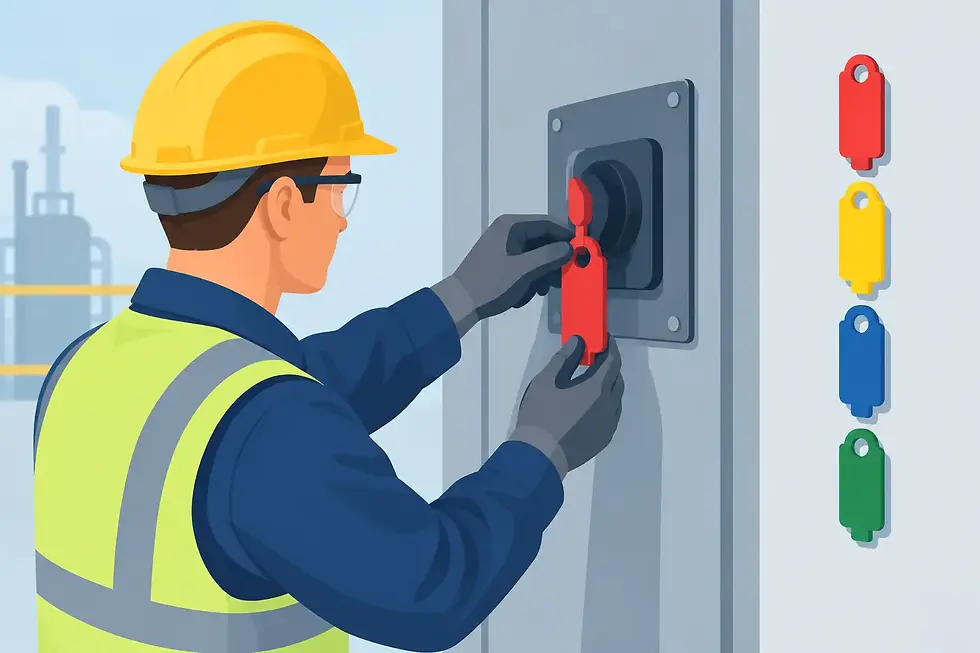
Establishing an electrically safe work condition. Workers need to understand the full sequence, not just the phrase. That includes identifying all possible sources of electrical supply, interrupting the load, opening disconnecting means, applying lockout/tagout devices, releasing stored energy, verifying isolation, and testing for absence of voltage using an adequately rated test instrument. The test instrument must be verified before and after testing. Skipping this process turns a supposedly de-energized task into energized work.
Shock and arc flash risk assessment. Training should explain that shock and arc flash are related but separate hazards. Shock protection focuses on exposed energized conductors and circuit parts, voltage, and approach boundaries. Arc flash risk depends on factors such as available fault current, protective device clearing time, equipment condition, and the task being performed. Workers must know that an arc flash label communicates vital hazard information, but does not eliminate the need to assess the assigned task.
PPE selection and limitations. PPE is necessary when hazards cannot be eliminated, but it is not permission to take unnecessary energized-work risks. Employees should understand the difference between everyday workwear, arc-rated clothing, voltage-rated gloves, face protection, hearing protection, and other task-specific equipment. They also need instruction on inspection, storage, care, and limitations. Damaged gloves, contaminated arc-rated garments, or an incorrectly assembled face shield can create false confidence.
Energized work controls. NFPA 70E strongly prioritizes de-energization. Where energized work is justified, workers need to understand the approval process, work planning requirements, boundaries, protective measures, job briefing expectations, and conditions that require an energized electrical work permit. Troubleshooting and testing can present legitimate energized tasks, but convenience, schedule pressure, or avoiding production interruption are not sufficient reasons to bypass safe work practices.
Label recognition and hazard communication. Labels must be readable, durable, and located where workers make decisions. Training should cover the information employees will see on arc flash, shock, voltage, disconnect, transformer, battery, solar, and lockout/tagout labels. A label supports safer action at the point of use only if the underlying data is current and the worker understands what it means.
Make Training Part of the Arc Flash Program
Arc flash studies, equipment labels, work procedures, and training should reinforce one another. If they do not, workers receive conflicting instructions at the worst possible moment.
For example, an arc flash label may identify incident energy and arc flash boundary at specific equipment. Training should explain how that label informs PPE and boundary decisions, while also teaching employees to stop and escalate concerns when the label is missing, damaged, outdated, or inconsistent with equipment modifications. A label is not a substitute for engineering analysis, equipment maintenance, or sound work planning.
Facilities should also explain what happens after system changes. Replacing a transformer, modifying protective settings, adding generation, changing utility service capacity, or altering distribution equipment can affect available fault current and protective device performance. Those changes may require an engineering review, revised labels, and updated training. Leaving old information in service creates an avoidable hazard and weakens the credibility of the entire program.
How to Evaluate a Training Provider
The right provider depends on the complexity of the facility, the roles being trained, and whether the organization needs instruction only or broader program support. A course designed for office personnel will not meet the needs of a team that performs energized diagnostics on switchgear.
Look for training grounded in current NFPA 70E requirements and applicable OSHA expectations. The instructor should be able to explain how standards apply to real tasks without making unsupported claims that a class alone guarantees compliance. Strong providers address practical controls, not only definitions and slides.
Ask whether the course can be tailored to your equipment, procedures, and workforce. Also ask how competency is verified. Written quizzes can confirm that attendees recognize key concepts, but hands-on tasks often require observation of work practices. For qualified workers, practical assessment is especially valuable for absence-of-voltage verification, lockout/tagout, test instrument use, and PPE application.
Training records should identify the course content, date, instructor, attendees, assessment method, and any limitations on authorization. Keep them organized with electrical safety program records, audits, equipment studies, and procedure updates. Records matter during audits and incident investigations, but their larger value is showing management where retraining or corrective action is needed.
Refresh Training Before the Program Drifts
Electrical safety knowledge degrades when workers do not apply it consistently. Refresher training should occur at intervals required by the applicable standard and whenever a change in job duties, equipment, procedures, technology, or observed work practices indicates a need. Retraining is also appropriate after an electrical incident, near miss, audit finding, or evidence that employees are not following established safety-related work practices.
Do not wait for a serious event to discover that workers cannot interpret labels, locate energy sources, or explain the difference between locking out equipment and merely turning it off. Field observations, job briefings, and periodic program audits can identify these weaknesses early.
ZMAC Safety Labels supports this approach by pairing NFPA 70E-based training with durable electrical hazard labeling and broader compliance tools. The practical value is consistency: the safety instruction, hazard information, and site procedures should tell workers the same thing.
The most effective electrical training does not end when employees leave the classroom. It shows up when a technician pauses at a panel, reads the label, follows the established isolation process, verifies absence of voltage, and refuses unnecessary energized work. That decision is where training becomes worker protection.


Comments