

NFPA 70E Compliance Guide for Facilities

A facility usually finds out its electrical safety program is weak at the worst possible moment - after a near miss, during an audit, or when a contractor asks for arc flash labels that are outdated or missing. A solid nfpa 70e compliance guide is not about paperwork for its own sake. It is about giving qualified and unqualified workers clear rules, current hazard information, and a work process that holds up when equipment must be serviced under real operating conditions.
NFPA 70E is often discussed as if it were a single task to complete. It is not. It is an operating framework for electrical safe work practices. If your site has switchboards, MCCs, panelboards, industrial control panels, transformers, disconnects, or battery systems, compliance depends on how those assets are assessed, labeled, maintained, and approached by workers every day.
What an NFPA 70E compliance guide should cover
An effective NFPA 70E compliance guide starts with scope. The standard addresses electrical safety in the workplace, with emphasis on shock hazards, arc flash hazards, risk assessment, training, and work practices. For most facilities, the practical question is not whether the standard applies. The question is where exposure exists and whether the organization can show a defensible process for controlling it.
That process usually includes an electrical safety program, documented risk assessments, equipment labeling where required, job planning, energized work controls, PPE selection, and worker training. It also depends on equipment condition. A well-written procedure cannot compensate for missing covers, poor maintenance, or field-marked gear with illegible hazard communication.
Compliance is also not identical across every site. A food plant with frequent washdown conditions, a hospital with continuity constraints, and a manufacturing campus with aging distribution equipment will not manage risk the same way. The standard sets the framework, but implementation depends on equipment, tasks, staffing, and operating constraints.
Start with the electrical safety program
If there is one place most facilities should begin, it is the written electrical safety program. NFPA 70E expects an employer to implement and document an overall program that directs activity appropriate to the risk associated with electrical hazards. That means roles, procedures, training expectations, audit practices, and the rules for when energized work is permitted or prohibited.
A weak program usually shows the same symptoms. Procedures are generic, responsibilities are unclear, and field execution varies by shift or department. Maintenance may follow one process, contractors another, and operations a third. That inconsistency creates preventable exposure.
Your written program should match the actual site. If a procedure says equipment will be placed in an electrically safe work condition before service, workers need a lockout process, disconnect identification, and labeling that make that step realistic. If the site depends on incident energy analysis, labels and PPE guidance must reflect current study results, not legacy values from prior system configurations.
Risk assessment is the center of NFPA 70E compliance
The standard is built around risk assessment, not just hazard recognition. Hazard tells you what can hurt someone. Risk considers likelihood and severity under the specific task and condition. That distinction matters because many facilities can identify electrical equipment, but fewer can show how task-based exposure is evaluated and controlled.
A shock risk assessment considers voltage, boundaries, and the protective measures required. An arc flash risk assessment considers the likelihood of an arc event and the potential severity of injury, then determines protective methods such as establishing an arc flash boundary, applying the incident energy analysis method, or using the PPE category method where permitted.
This is where shortcuts become expensive. If equipment has been modified, protective device settings have changed, or utility data is outdated, your analysis may no longer support the label in the field. The result is false confidence, which is worse than uncertainty because it leads people to act on bad information.
Labeling is not optional field decoration
For many facilities, labeling is the most visible sign of compliance, but it is also one of the most misunderstood. Arc flash labels are not there to satisfy a visual preference. They communicate hazard information at the point of use, where a worker decides whether they are qualified, what PPE is required, and whether the task should proceed at all.
Under NFPA 70E, equipment likely to require examination, adjustment, servicing, or maintenance while energized must be field marked with warning information. The exact label content depends on the method used, but it generally includes key hazard data such as nominal system voltage, arc flash boundary, and either incident energy information or the required PPE-related information allowed by the standard.
Durability matters here. A paper label or a low-grade adhesive solution is not a serious control measure in industrial conditions. Heat, oil, chemicals, UV exposure, washdown, and routine abrasion can quickly make critical hazard information unreadable. The label has to remain legible and attached in the environment where the equipment actually operates.
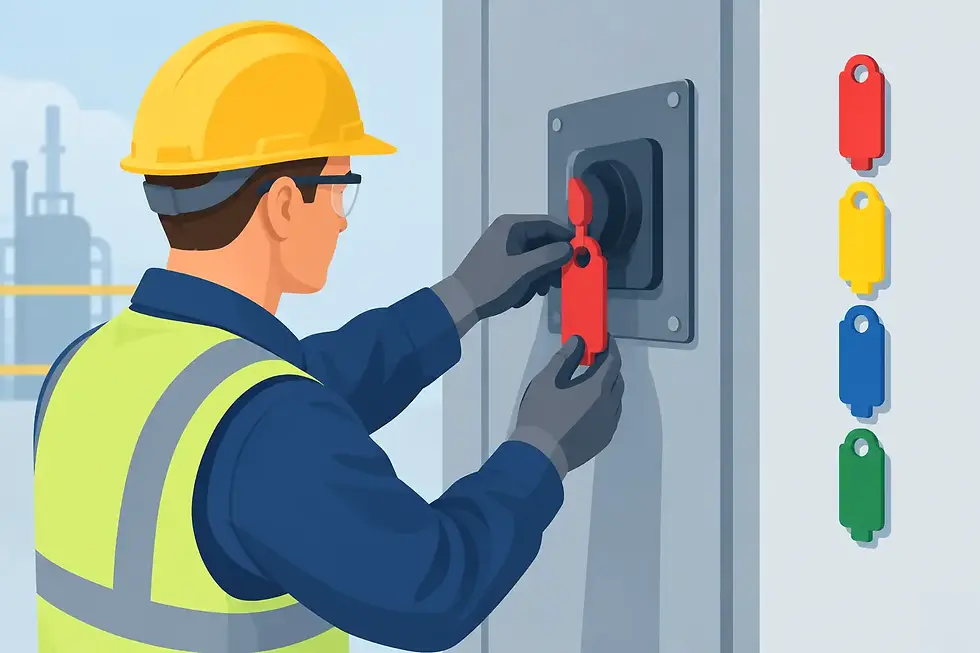
The same logic applies beyond arc flash labels. Disconnect labels, voltage markers, transformer hazard labels, battery warning labels, solar system labels, and lockout-related identification all support safer decision-making. Compliance is stronger when workers can identify the asset, understand the hazard, and follow the required control steps without guessing.
Training and qualification determine whether the program works
A facility can have current studies, excellent labels, and polished procedures and still fail if workers are not trained to apply them. NFPA 70E requires employees exposed to electrical hazards to be trained to understand the specific hazards associated with their work and the methods used to reduce risk.
The critical distinction is between qualified and unqualified persons. A qualified person is not simply an experienced employee or a licensed electrician. Qualification depends on demonstrated skills and knowledge related to the construction and operation of the equipment and the hazards involved. That means task-specific capability, not title alone.
Training should cover shock and arc flash hazards, approach boundaries, PPE use, test instrument use, job planning, and the process for establishing an electrically safe work condition. It should also address what workers are not allowed to do. Many incidents start when someone crosses from familiar work into energized exposure without recognizing the threshold.
Refresher training matters when audits reveal noncompliance, when new technology or procedures are introduced, or when workers are assigned duties that differ from prior responsibilities. In practice, training should follow system changes and field realities, not just a calendar.
Maintenance, documentation, and audits close the gaps
Facilities often focus heavily on labeling and PPE because those are visible. The harder work is maintaining the underlying program. Protective devices must be maintained so fault clearing assumptions remain credible. Single-line diagrams must reflect the actual system. Equipment changes must be captured so studies and labels can be reviewed and updated.
Documentation is where many organizations lose defensibility. If asked how incident energy values were established, who is trained, when the last audit occurred, or whether equipment was placed in an electrically safe work condition before service, the answers should be documented and retrievable. Memory is not a compliance system.
NFPA 70E also expects auditing of both field work practices and the electrical safety program itself. These audits are not busywork. They are how a facility finds drift before drift becomes injury. If workers routinely bypass boundaries, wear incorrect PPE, or rely on handwritten panel descriptions because engraved identification is missing, the audit should trigger corrective action.
Common implementation mistakes in NFPA 70E compliance
The most common mistake is treating compliance as a one-time project. A study gets completed, labels go on equipment, and the site assumes the problem is solved. But electrical systems change. Feeders are added, utility contributions shift, transformers are replaced, and settings are adjusted. Compliance decays unless there is a process to keep data current.
The second mistake is overreliance on generic templates with no site adaptation. Templates are useful starting points, but they must reflect the equipment, tasks, and staffing model of the facility. Otherwise, the written program describes a workplace that does not exist.
The third mistake is weak hazard communication in the field. Missing labels, poor label materials, inconsistent naming conventions, and illegible disconnect identification create friction at exactly the point where workers need clarity. ZMAC Safety Labels addresses this practical side of compliance by pairing standards-based labeling with the broader tools facilities need to support electrical safety execution.
Building a practical NFPA 70E compliance path
If your facility is trying to improve quickly, start by identifying the gap between what the standard expects and what workers experience in front of energized equipment. Review your electrical safety program, confirm training records, examine field labels for accuracy and durability, and verify that studies and documentation reflect the present system.
Then look at what causes hesitation or improvisation in the field. If workers cannot easily identify equipment, if lockout points are confusing, if labels are damaged, or if qualified personnel are relying on tribal knowledge, the compliance problem is already operational. That is where corrective action should begin.
A useful NFPA 70E program does not just reduce citation risk. It reduces uncertainty. When the label is readable, the task is planned, the worker is trained, the boundary is understood, and the equipment data is current, safety becomes more consistent under pressure. That consistency is what protects people when routine work stops being routine.


Comments