
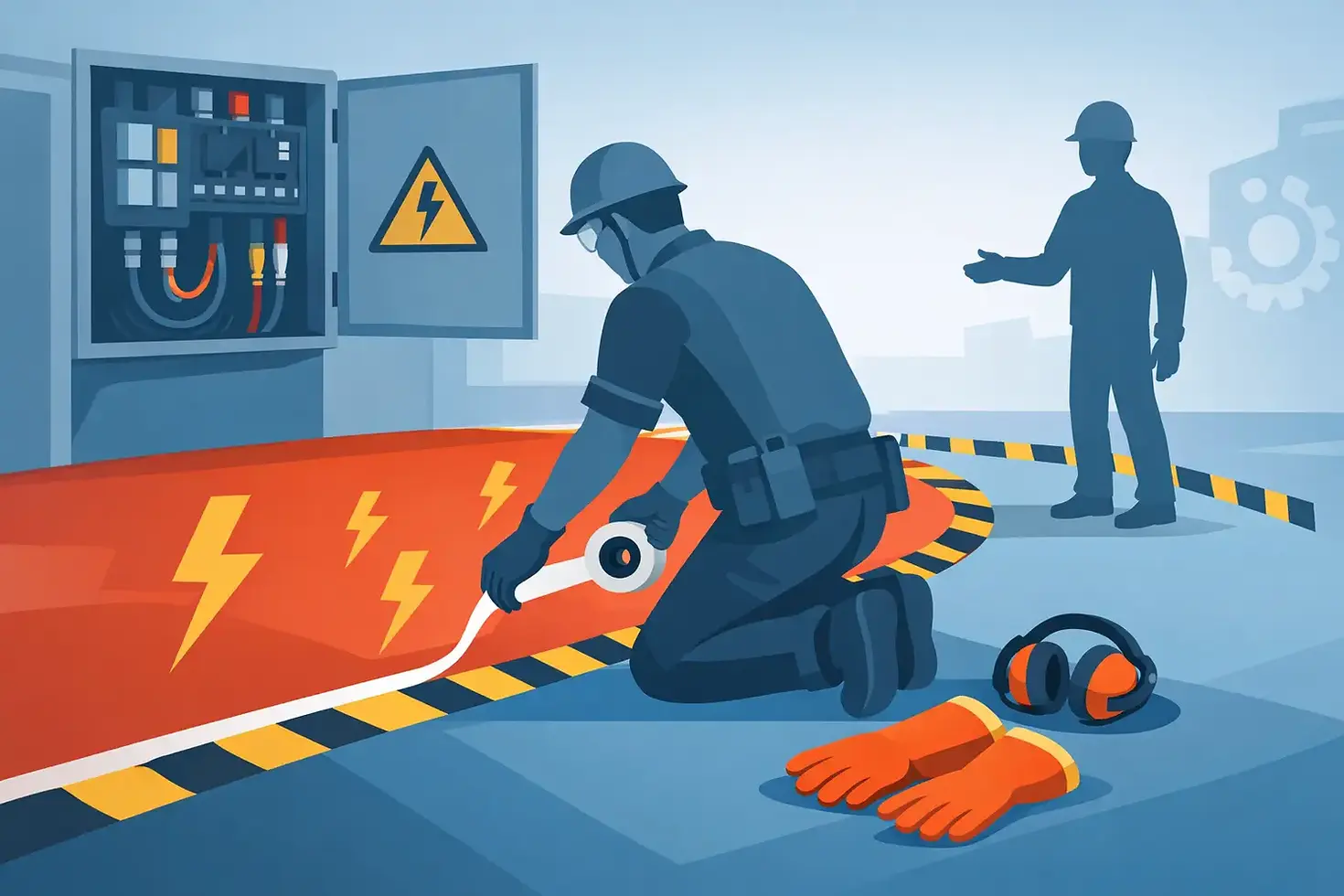
Shock Hazard Boundary Labeling Done Right
- Alfred Craig

- Jun 26
- 5 min read
A qualified worker opens a panel, sees the voltage marking, and still lacks one critical piece of information - how close is too close? That gap is where shock hazard boundary labeling matters. When labels clearly communicate approach boundaries and shock exposure at the equipment, they support faster decisions, safer troubleshooting, and stronger alignment with NFPA 70E-based electrical safety programs.
Why shock hazard boundary labeling matters
Shock incidents are not limited to major failures or dramatic arc flash events. Routine tasks such as testing, opening enclosures, removing covers, or verifying absence of voltage can place workers within reach of energized conductors and circuit parts. If the shock boundaries are not communicated clearly, the risk shifts from controlled exposure to guesswork.
That is a serious operational problem. Facilities may have studies, written procedures, and training records in place, but the point of use is where decisions happen. Labels help translate engineering and program requirements into a visible warning on the actual asset. For maintenance teams, contractors, and supervisors, that visibility reduces ambiguity when time is limited and equipment must be evaluated quickly.
Shock hazard boundary labeling also strengthens consistency across a site. One panel marked correctly while another remains vague or outdated creates uneven expectations. Workers should not have to infer approach limits based on memory alone, especially in facilities with mixed voltages, legacy gear, and multiple trades interacting with electrical equipment.
What shock hazard boundary labeling should communicate
A label is not a substitute for training, energized work justification, or a proper risk assessment. It is one part of the larger hazard communication system. Still, when the label content is weak, the rest of the program is harder to execute in the field.
For many facilities, effective shock hazard labeling begins with accurate equipment-specific information. That may include nominal system voltage, shock approach information where applicable, and warnings that energized parts inside can expose workers to electric shock. Depending on the equipment, the label may also need to coordinate with arc flash information, PPE requirements, restricted access language, or safe work instruction references.
The right label content depends on the task and the way your electrical safety program is structured. Some organizations prefer separate labels for shock and arc flash hazards. Others combine key data into one engineered equipment label to reduce clutter. Either approach can work if the result is readable, current, and aligned with the underlying analysis.
NFPA 70E and the role of approach boundaries
NFPA 70E is central to this discussion because it defines shock protection concepts that many employers use to build compliant work practices. The standard addresses approach boundaries intended to protect workers from shock exposure when interacting with energized electrical conductors and circuit parts. In practice, these boundaries help define when a person must be qualified, what precautions apply, and when additional protective measures are required.
This is where labeling helps, but also where facilities need to be careful. A shock boundary label should not be treated as a generic sticker applied the same way across every asset. The information must reflect the system voltage and the current requirements of the facility's electrical safety program. If the label references outdated approach distances or uses language disconnected from current NFPA 70E procedures, it can create false confidence rather than real protection.
There is also a practical difference between code compliance and field usability. A label may technically include required information but still fail if the text is too small, the layout is confusing, or the material degrades in heat, moisture, chemicals, or UV exposure. In industrial settings, durability is not a branding preference. It is a safety requirement.
Common problems with shock hazard boundary labeling
The most common failure is oversimplification. Facilities sometimes install generic electrical warning labels that say little more than danger or high voltage. Those warnings may have a place, but they do not provide enough guidance for workers who need to understand whether they are approaching an energized hazard zone and under what conditions.
A second problem is inconsistency. One contractor may label switchboards one way, an in-house team may label motor control centers another way, and older equipment may still carry markings from a previous standard or study. When labels do not follow a unified site convention, even qualified personnel slow down to verify what they are seeing.
A third issue is poor lifecycle control. Electrical systems change. Overcurrent devices are adjusted, transformers are replaced, available fault current shifts, and studies are updated. If the facility updates the engineering but leaves old labels in place, the label becomes a liability. Hazard communication only works when the installed marking matches the current condition of the equipment.
How to implement shock hazard boundary labeling effectively
Start with the underlying data. Before applying or revising labels, confirm that equipment inventories, voltage information, and study outputs are accurate. If your facility relies on arc flash studies, SKM or ETAP models, or field verification records, those inputs should support the labeling program rather than sit in isolation.
Next, decide how shock information will be presented across the site. The best choice depends on the complexity of the facility and the users. In some plants, a combined label format improves speed and consistency. In others, dedicated shock labels on specific equipment types are easier to maintain. The key is standardization. Workers should recognize the format immediately and know where to look for critical information.
Material selection matters more than many organizations expect. Labels placed on electrical equipment in manufacturing plants, utilities, water facilities, or outdoor installations face abrasion, oil, washdowns, heat, and sunlight. Paper-based or low-grade materials may look acceptable on day one and fail long before the next audit cycle. A shock warning that curls, fades, or delaminates is not performing its function.
Facilities should also define who owns label updates. In many organizations, no single team controls the process, so revisions get delayed after maintenance projects or engineering changes. EHS may own the policy, engineering may own the calculations, and maintenance may install the physical labels. Without a clear handoff, outdated hazard communication remains in service.
Where labeling fits in a full safety program
Shock hazard boundary labeling works best when it is tied to training, procedures, and equipment condition. Workers need to understand what the boundary means, which tasks are permitted, when energized work is prohibited, and how the label interacts with lockout/tagout, test-before-touch practices, and absence-of-voltage verification.
This is especially important for mixed audiences. A facility manager may need assurance that the labeling program supports OSHA and NFPA 70E expectations. A maintenance supervisor needs equipment in the field marked consistently enough that technicians can act without hesitation. An electrical contractor needs labels that match site rules and engineering data. Good labeling supports all three, but only if the program was built with actual use conditions in mind.
For that reason, many facilities treat labeling as part of broader compliance infrastructure rather than a stand-alone purchase. Durable labels, engineering support, data management, and NFPA 70E-based training all reinforce each other. ZMAC Safety Labels operates in that space because equipment marking only solves part of the problem unless the site also has reliable technical inputs and a workable implementation process.
Getting the label right at the equipment
At the equipment level, the goal is clarity. Workers should be able to identify the hazard, understand whether shock boundaries apply, and recognize that additional procedures may govern access. The label should be legible at the point where a decision is made, not hidden behind hardware, crowded by unrelated markings, or buried in a mass of inconsistent signage.
There is no value in a label that looks compliant from a purchasing desk but fails in front of energized equipment. The right shock hazard boundary labeling program is specific, durable, maintained, and connected to the real conditions of the electrical system. When that happens, labeling stops being a sticker exercise and starts functioning as intended - a direct control that helps people pause, assess, and stay outside the line that should never be crossed casually.
If your facility is reviewing electrical hazard communication, this is a good place to be demanding. Workers only get one chance to read a label before exposure becomes immediate.


Comments