

Solar PV Warning Labels Done Right
- Alfred Craig

- May 1
- 6 min read
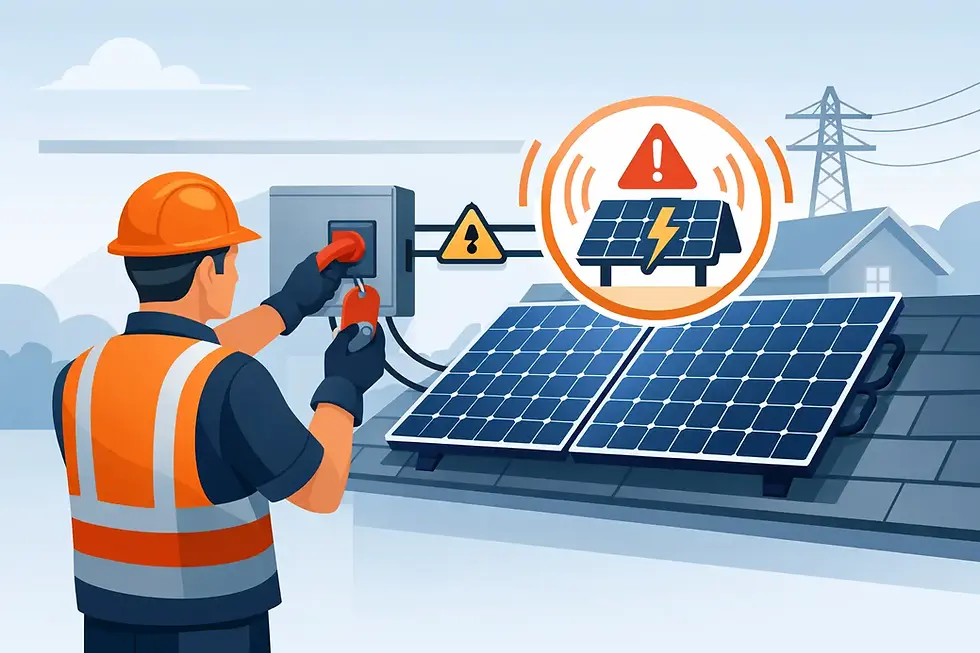
A disconnect that looks ordinary can still be fed by a rooftop array two buildings away. That is why solar PV warning labels are not a minor finishing step. In commercial and industrial facilities, they are a frontline hazard communication control that helps qualified workers identify backfeed sources, understand system configuration, and avoid dangerous assumptions during operation, troubleshooting, and emergency response.
Why solar PV warning labels matter
Photovoltaic systems change the way electrical hazards present themselves in a facility. With utility-only systems, crews often expect one primary source and a familiar shutdown sequence. Solar changes that. Conductors can remain energized under sunlight, equipment may be supplied from multiple directions, and rapid shutdown or energy storage components can add layers of complexity that are not obvious from the enclosure alone.
That complexity is exactly where labeling matters. A clearly marked PV system gives maintenance staff, electrical contractors, inspectors, and emergency personnel immediate context at the point of work. It reduces the chance of opening the wrong disconnect, misidentifying the source of voltage, or assuming a panel is de-energized when it is still receiving power from another path.
For facility leadership, the value is also operational. Good labeling supports safer maintenance planning, smoother inspections, fewer delays during service calls, and a more defensible compliance posture when OSHA-aligned hazard communication expectations come under review.
What the NEC expects from solar PV warning labels
The National Electrical Code has long required specific field-applied markings for photovoltaic systems, and those requirements have evolved as PV technology has become more common and more complex. The exact label set depends on the system design, the code edition in force, and whether the installation includes items such as rapid shutdown equipment, multiple power sources, DC circuits, energy storage interfaces, or point-of-interconnection markings.
The practical takeaway is simple: solar labeling is not one sticker on one disconnect. It is a coordinated identification system across service equipment, distribution equipment, combiner boxes, disconnects, raceways where required, inverters, and other relevant components.
A compliant labeling approach typically addresses several issues at once. It warns that the system contains multiple sources of power. It identifies photovoltaic power sources and output circuits. It communicates shutdown information where required. It marks DC equipment and circuit characteristics where applicable. It also helps locate associated equipment quickly, which becomes critical during maintenance and emergency operations.
Because NEC requirements vary by equipment type and application, facility teams should avoid a copy-and-paste approach. What works for a small rooftop array on a retail building may not be sufficient for a large commercial or industrial installation with service-entrance interconnection, battery storage, and multiple disconnecting means.
Compliance is not just about passing inspection
Inspection is one checkpoint, not the full objective. The deeper purpose of these labels is hazard recognition. If a label meets a code citation but is unreadable after one summer, placed where no one can see it, or written in vague language that does not match the actual system, it is not doing its job.
That is why serious safety programs treat NEC labeling as a minimum baseline and then ask a more practical question: will this marking still help a qualified worker make the right decision under pressure?
Where solar PV warning labels are commonly needed
Most PV labeling failures are not caused by the wrong adhesive or the wrong color. They happen because the site team missed where labels were needed or failed to treat the system as a connected whole.
At a minimum, teams should review the labeling needs at PV disconnects, AC and DC disconnecting means, combiner boxes, inverters, service equipment, distribution panels with backfed sources, meter locations, rapid shutdown initiation devices, and any equipment where multiple sources or unusual operating conditions create a hazard. Depending on the installation, placards may also be needed to identify rooftop arrays, battery systems, power conversion equipment, and the location of associated disconnects.
The right placement depends on the task. A label should be visible before a worker performs the action that creates exposure. If someone has to open a door, move conduit, or walk around the equipment to discover that a second source exists, the warning came too late.
What makes a label effective in the field
A solar warning label has to do more than exist. It has to stay legible, stay attached, and communicate clearly in real conditions. Industrial and commercial environments are hard on labels. UV exposure, heat cycling, washdowns, chemicals, dust, and abrasion all work against readability over time.
That is why material selection matters. A paper-style label or low-grade adhesive may look acceptable on day one and fail when the first maintenance interval arrives. Durable polyester or other industrial-grade constructions are a better fit for long-term service, especially outdoors or in harsh indoor environments.
The message itself also matters. Wording should be direct and standardized where code language applies. Handwritten substitutions, generic caution text, or labels that leave out key source information create room for interpretation. In electrical safety, interpretation is where incidents start.
Formatting plays a role as well. The print must be large enough to read quickly. Signal words and contrast should support visibility. Labels should be applied to clean, suitable surfaces and positioned where operating personnel naturally look before interacting with the equipment.
Durability and accuracy have to work together
There is a trade-off some facilities make without realizing it. They either choose a rugged label with generic wording, or a highly customized label made on a material that does not last. Neither is enough.
The best result is a label set that reflects the actual installed system and is built for the environment where it will be used. That means matching the message to the equipment and using materials that can tolerate years of exposure without fading, peeling, or becoming unreadable.
Common mistakes that create risk
One common problem is treating solar labeling as an afterthought at project closeout. By then, equipment has been installed, documentation may be scattered, and the final label package is assembled from memory instead of verified drawings. That is how teams end up with missing source labels, inconsistent terminology, or shutdown instructions that do not match the as-built condition.
Another issue is relying only on the installer's standard kit. Some installers do excellent work, but standard kits are often designed for broad use cases, not the specifics of your facility. If the project includes unusual interconnections, tenant-fed equipment, service modifications, or battery integration, a generic label package can leave serious gaps.
Facilities also run into trouble when labels are not maintained after system changes. Inverter replacement, feeder rerouting, added disconnects, and storage retrofits can all make existing warnings inaccurate. A stale label is often more dangerous than no label because it gives workers false confidence.
Finally, many organizations separate electrical labeling from the larger safety program. Solar markings should not live in a silo. They should align with arc flash labeling, lockout/tagout procedures, one-line diagrams, training, and documented shutdown methods.
How to build a better solar PV warning labels program
The most reliable approach starts with a field verification of the actual system. Review current one-lines, identify all source points and disconnecting means, and compare documentation against installed conditions. Do not assume older drawings reflect later modifications.
From there, map the required labels by equipment type and hazard scenario. Some labels address NEC identification requirements. Others support safer operation by clarifying source relationships, shutdown sequence, or equipment location. Both matter.
Then standardize the label format across the site. Consistent signal words, color schemes, materials, and terminology help workers process information faster. Consistency also makes future expansions easier to manage.
After installation, fold label inspection into preventive maintenance and electrical safety audits. Check for legibility, adhesion, UV damage, and relevance after any system modification. If the facility already reviews arc flash labels periodically, solar labels should be part of the same discipline.
For organizations with multiple facilities, this is where a specialized compliance partner can add value. ZMAC Safety Labels supports facilities that need rugged field-applied labels and a broader electrical safety framework that holds up under real operating conditions.
Solar labeling is part of risk reduction, not decoration
Electrical workers do not need more visual clutter. They need accurate warnings that tell them what they are dealing with before they touch the equipment. Solar systems introduce persistent energy sources, non-obvious backfeed conditions, and shutdown challenges that are easy to underestimate when the labeling is weak or inconsistent.
Well-designed solar PV warning labels help turn a complicated system into one that can be understood quickly and worked on more safely. If your facility has PV equipment, the right time to verify those labels is before the next service call, not after someone discovers the hazard the hard way.
A label cannot eliminate electrical risk, but it can stop a bad assumption at exactly the moment it matters most.


Comments